Tags
Memorial Day is a federal holiday observed annually on the last Monday in May. It is one of the most solemn holidays in the United States. It honors those who gave their lives in service to this country. Memorial Day’s history stretches back to the Civil War, when it was known as Decoration Day. May 30 was designated to decorate the graves of soldiers who died in defense of their country, and whose bodies now lie in almost every city, village, and churchyard in the land.
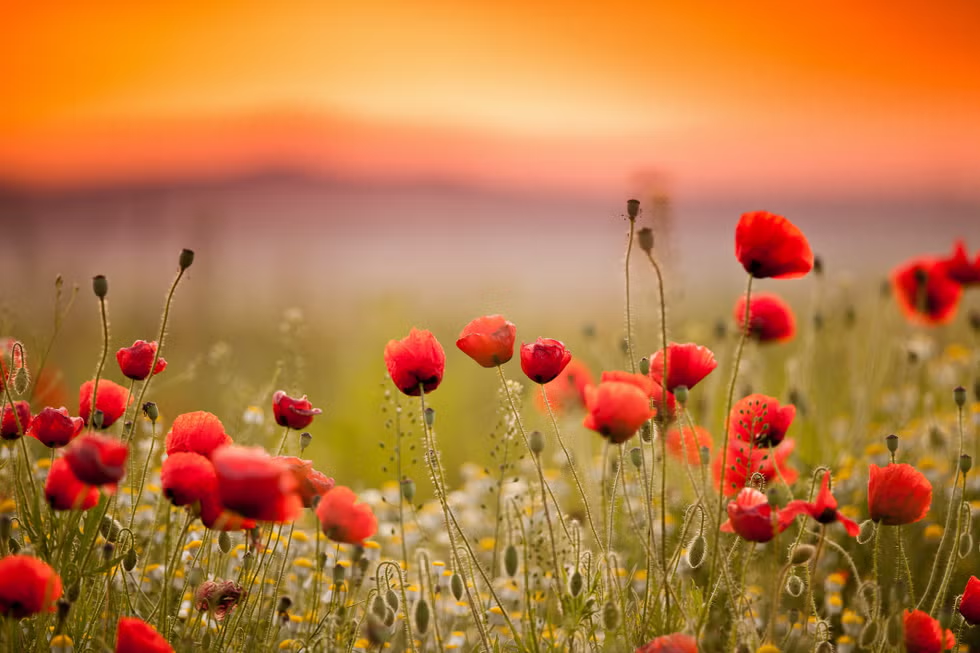
The poppy is a symbol of Memorial Day. In the war-torn battlefields of Europe, the familiar red field poppy was one of the first plants to reappear. A Canadian soldier and physician, John McCrae, witnessed the war firsthand and was inspired to write the now-famous poem “In Flanders Fields”.
In Flanders fields the poppies blow
Between the crosses, row on row,
That mark our place; and in the sky
The larks, still bravely singing, fly
Scarce heard amid the guns below.
We are the Dead. Short days ago
We lived, felt dawn, saw sunset glow,
Loved and were loved, and now we lie
In Flanders fields.
Take up our quarrel with the foe:
To you from failing hands we throw
The torch; be yours to hold it high.
If ye break faith with us who die
We shall not sleep, though poppies grow
In Flanders fields.
The poppy is now worn on Memorial Day in the United States to honor all fallen servicemen and women from all wars. I have a small, red, cloth poppy given to me by a now-deceased fellow Vietnam veteran and fellow helicopter pilot. I keep it on my desk. It reminds me of him and some of my friends with whom I served in Vietnam in B Troop 3/17 Air Cavalry in 1970. They paid the ultimate price for serving their country. These young men agreed to go to war when their nation asked. They trusted their president and military commanders and knew the ultimate sacrifice could be necessary. Lest I forget them:

Jerome was probably my favorite doorgunner. He was a handsome, gregarious young black man from Atlanta, GA. I knew he smoked a lot of pot and was always finding his way with certain Vietnamese ladies of the night. But he was never late for work and did his job enthusiastically. He loved flying as a door gunner in the Huey and always kept his M60 machine gun in tip-top shape. He would tether himself in a body harness and stand on the skid of the Huey with his M60 cradled in his arms, firing offhand at the targets below. That approach to door gunning ended when the Army declared that the machine guns would be kept on their fixed posts because too many tips of the main rotor blades were being hit by their own gunners in a hard right bank. Door gunning was one of the most vulnerable jobs in the War. Jerome took an enemy bullet to the neck and was killed instantly. RIP, Jerome.

I knew James briefly at Fort Hunter in Savannah, GA, before we arrived in Vietnam. He received training and an eventual transition in the Cobra gunship as I finished advanced training in the Huey. James was from a Quaker community in eastern Ohio. His family were pacifists but supported James’ desire to serve his country. By chance, we ended up in the same unit in Vietnam. During a gun run on an enemy 51 caliber machine gun nest, an enemy round blasted through the dashboard of the Cobra and through James’ chest plate armor, which instantly killed him. My crew chief removed James’ body from the downed Cobra, and we flew him to the Third Field Hospital in Saigon for his trip back home. RIP, James.

Ted was a First Lieutenant Scout pilot who, like me, at age 24, was a bit older than most of our pilots. Unlike me, he was married with two small children. Nonetheless, we shared many familiar things and were good friends. One day in the war zone, Ted and Tommy, his crew chief/observer in the right seat, went missing. They had hit a high-voltage powerline, the only one in the country then, and it wasn’t even operational. Ted was thrown from the cockpit, and Tommy, his crew chief, burned with the aircraft on the ground. Both died instantly, probably before the helicopter hit the ground. My Huey crew and I were the first to find them shortly after they crashed. RIP, Ted and Tommy.

As we spend this weekend with family and friends, let’s be grateful for those who made the ultimate sacrifice for us and our country.
Peace.
 Boxxer's Blog
Thank you for sharing your stories, and for your service. MBA
LikeLike
Thank you, Jim. I’m so grateful for your sharing these important memories. There is much pride for their service and yours. But also much sadness in all the tragic loss.
LikeLike